A reading guide to Against Nature

A first reading
of Against Nature.

Joris-Karl Huysmans’s Against Nature (1884) spends long stretches with Des Esseintes as he chooses books, studies paintings and experiments with perfume. Many of the names will be unfamiliar on a first reading. The notes can help, but you can follow his enthusiasms, memories and discomforts without looking up every reference.

Getting used to Huysmans’s pace.

  1. Give the descriptions some time.

    Huysmans may spend several pages on the colour of a room or a writer Des Esseintes admires. These choices gradually introduce his character. His reasons for disliking something can be especially revealing, and often funny.

  2. Look up what interests you.

    A list of unfamiliar poets need not interrupt your reading. You can return to it later, or consult a note when a particular name or detail makes you curious. The chapter endnotes are there to explain references without requiring you to stop at every one.

  3. Notice his physical condition.

    Des Esseintes’s health affects what he can enjoy. Smells linger when he wants them gone, food becomes difficult, and the pleasures he has arranged demand more than he can tolerate. His bodily discomfort gives the long descriptions a growing sense of urgency.

  4. Take his certainty with some scepticism.

    Des Esseintes has strong opinions about almost everything, from Latin prose to the colours of flowers. Huysmans gives these judgements plenty of room, including their absurdity. You can enjoy the detail of an opinion without accepting the man who holds it as your guide.
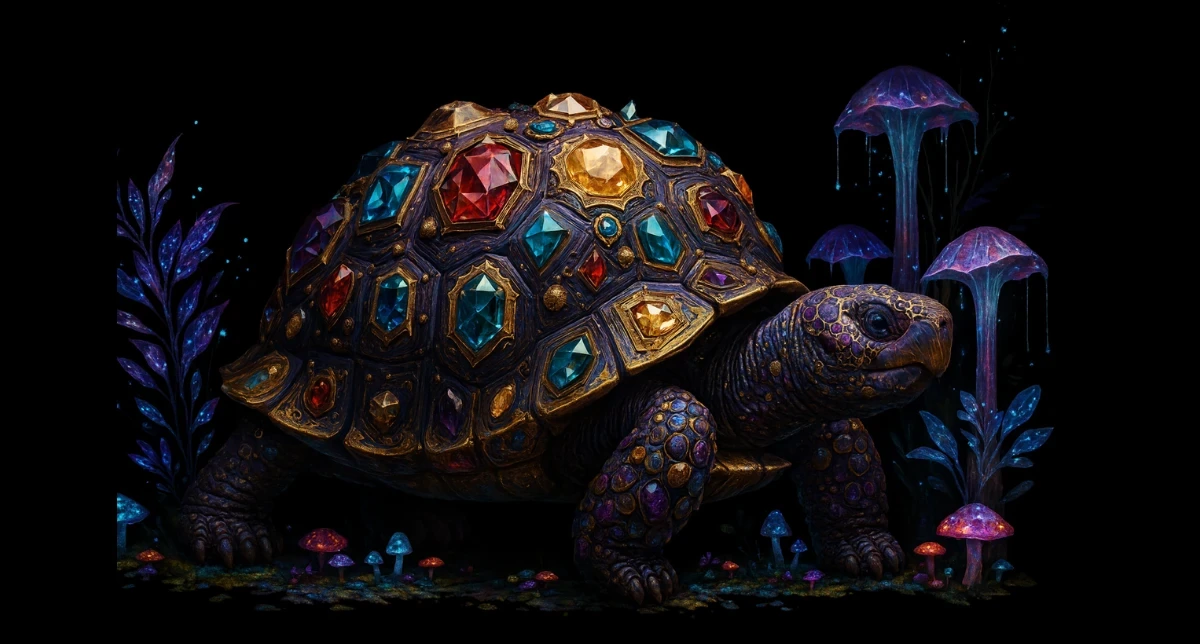

A visual interpretation of the jewelled tortoise in Against Nature

Chapter IV / The jewelled tortoise

The tortoise
on the carpet.

In Chapter IV of Joris-Karl Huysmans’s Against Nature (1884), Des Esseintes wants a tortoise’s shell to complement his carpet. He has it gilded, then set with carefully chosen stones. The attention he pays to their colours makes his disregard for the animal increasingly difficult to overlook.

Reveal the episode’s outcome · spoiler

The tortoise dies after its shell has been gilded and covered with gemstones. Huysmans ends the episode abruptly, after the long account of Des Esseintes’s preparations.

How does the long description of the gemstones affect your response to the tortoise’s fate?

Chapters IV & X / Crossing the senses

His experiments
with taste and scent.

In Joris-Karl Huysmans’s Against Nature (1884), Des Esseintes associates liqueurs with musical instruments in Chapter IV and blends perfumes in Chapter X. Both episodes describe the knowledge and equipment behind his experiments. They also show how easily a carefully arranged pleasure can become exhausting or oppressive.

Try the mouth organ →
Ruby glass and jewel-coloured perfume clouds, an imaginative illustration of the novel’s sensory world

Questions for
a reading group.

  1. Which of Des Esseintes’s pleasures would you like to try, and which repel you?
  2. When does the house feel like a refuge? When does it feel like a trap?
  3. Which of his judgements made you laugh, and which made you uncomfortable?
  4. How do the Auguste Langlois episode in Chapter VI and the memories in Chapter IX affect your view of Des Esseintes?
  5. Do you recognise anything of your own habits in the way he arranges his surroundings?

Reader questions

A few things to know.

Is Against Nature difficult?

Against Nature can be demanding, especially in its long discussions of literature, religion and art. Much of it is also concrete: a room being furnished, a perfume being mixed, a meal going wrong. Following those scenes first can make the more specialised passages easier to approach.

How is it connected to The Picture of Dorian Gray?

Against Nature is widely associated with the unnamed yellow book that fascinates Dorian in Oscar Wilde’s novel. Readers coming from Dorian Gray will recognise the interest in art, luxury and their influence on a person’s life. The association is also noted in Penguin’s description of Robert Baldick’s translation.

Does it contain disturbing material?

Yes. Against Nature includes animal cruelty, sexual exploitation, misogyny, racial and religious prejudices, and descriptions of illness. Chapter VI includes Des Esseintes’s calculated attempt to corrupt a teenage boy. The edition retains this material, with contextual endnotes.

Image detail